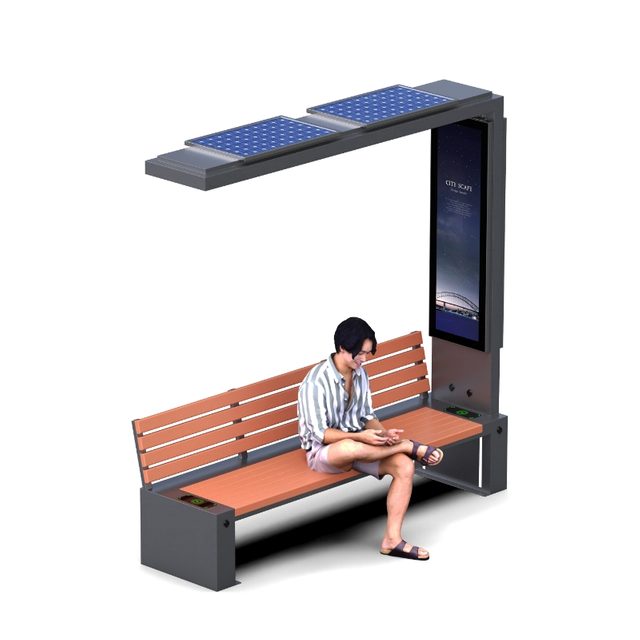
Public spaces are being asked to do more than provide a place to pass through. People need somewhere to rest, charge a phone, check directions, wait safely, or stay connected without adding more pressure to city infrastructure. A Solar Charging Bench responds to that need by turning everyday seating into a practical, solar-powered service point. When used in the right location, it can support cleaner outdoor amenities, improve comfort in parks and transit areas, and help planners choose public furniture that serves real urban sustainability goals.
Why Solar Charging Benches Support Urban Sustainability
Turning ordinary seating into low-impact public infrastructure
Benches already belong in public environments, so upgrading them can add function without forcing major spatial changes. A park path, campus courtyard, pedestrian street, or transit waiting area may already need seating; adding charging and lighting turns that same footprint into a more useful service point. This is why a Solar Charging Bench can feel natural in urban infrastructure planning: it does not ask users to change their behavior before they receive value. People sit, rest, wait, check their phones, and continue their journey.
Sustainability also depends on how well a public asset is used over time. A bench that supports phone charging, evening visibility, or outdoor comfort can extend the usefulness of a public space without adding a separate kiosk, power pole, or charging cabinet. The environmental value is not only the use of sunlight. Better use of existing public furniture can reduce clutter and make outdoor areas work harder within the same limited urban space.
Reducing wiring needs in suitable outdoor locations
Solar-powered seating can be especially useful where external wiring is inconvenient, expensive, or visually disruptive. Parks, plazas, campuses, scenic areas, and pedestrian streets often have open areas where trenching and cabling can be complicated. In those locations, an independently powered Solar Charging Bench may provide basic charging and lighting services without requiring the same installation process as a grid-connected fixture. ZEMSO’s ZY-0005 model uses an 80W solar panel with integrated battery storage and is designed for independent operation without an external power connection.
That benefit still has limits. Solar benches need enough sunlight, suitable placement, and realistic power expectations. A shaded courtyard, narrow street canyon, or winter-heavy location may not deliver the same performance as an open plaza with strong daylight. Treating solar seating as a flexible public amenity, rather than a universal replacement for wired infrastructure, leads to better planning decisions and fewer performance disappointments.
Where Solar Charging Benches Create the Most Value
Parks, plazas, and pedestrian streets
Parks and plazas are natural locations for solar-powered seating because people already use these spaces for resting, meeting, reading, and spending time outdoors. A Solar Charging Bench can make that stay more practical by helping visitors charge a phone, check a map, use mobile payment, or contact someone without leaving the area. Lighting can also make a bench easier to find in the evening, especially along pedestrian routes or near gathering points. The result is not a dramatic redesign of the public space, but a small improvement that supports longer and more comfortable use.
Pedestrian streets benefit in a different way. Visitors may be walking between shops, public transport, cultural sites, or offices, and a short charging stop can reduce friction during the day. Comfortable seating with solar-powered utility can support both movement and pause, which is important in human-centered urban design. When charging, lighting, and seating work together, the bench becomes part of the street experience rather than a separate piece of technology.
Campuses, scenic areas, and commercial public spaces
Campuses and scenic areas often have long dwell times. Students may wait between classes, tourists may spend hours outdoors, and workers may use open spaces during breaks. In these settings, a Solar Charging Bench can support mobile connectivity without making the area feel overly commercial or overbuilt. The user simply sees a place to sit that also solves a common problem: a low battery during the day.
Commercial public spaces can also benefit when the design fits the surrounding environment. A bench near a business district, waterfront, resort path, or visitor center can improve comfort while keeping the infrastructure clean and integrated. ZEMSO’s solar bench category includes models designed around charging, lighting, and connectivity for outdoor spaces, including campuses and smart-city environments. Used with restraint, that type of furniture can support public convenience without turning every seating area into a technology display.
Transit stops and waiting zones
Transit stops and waiting areas have a simple but important user need: people need information while they wait. A charged phone helps passengers check routes, receive delay updates, access digital tickets, call a ride, or contact family. A Solar Charging Bench cannot fix route frequency, traffic congestion, or station design, but it can make the waiting experience less stressful. That is where its urban mobility value becomes realistic.
Waiting zones also need furniture that can handle repeated use. A bench in a bus stop, taxi area, or transport hub must be visible, durable, and easy to understand. If charging ports are hard to find or lighting feels poorly placed, the technology becomes less useful. The strongest applications are usually locations where people already pause long enough for the bench to matter.
Features That Matter More Than Extra Technology
Charging access people can actually use
Charging is the core function that most users notice first. A Solar Charging Bench should make that function obvious, accessible, and compatible with common devices. USB, Type-C, and wireless charging each serve different habits: some users carry cables, some expect newer connectors, and others prefer a cable-free surface for a quick top-up. ZEMSO’s ZY-0005 supports wireless charging, USB charging, and USB Type-C charging, making it a useful example of multi-interface design for public mobile-device use.
The best charging setup is not only about adding more ports. Placement matters because users should not have to bend awkwardly, expose cables to foot traffic, or guess which surface supports charging.
Lighting, broadcasting, and comfort functions
Lighting can be valuable when it improves visibility, orientation, and the feeling of safety. A softly lit bench near a walking route, transit stop, or plaza edge can help people identify resting areas after dark. Ambient lighting should support the site rather than overpower it. When lighting is too bright, poorly directed, or inconsistent with the streetscape, the bench may feel more like a gadget than a public amenity.
Broadcasting and comfort functions should be selected with the same discipline. Smart speakers may be useful for public notices, campus announcements, scenic-area guidance, emergency alerts, or temporary event information. ZEMSO’s ZY-0005 includes a customizable smart speaker for music, public information, emergency alerts, and customized audio content, while heated seating is available as an optional project-based feature. Heated seating may make sense in cold regions, but it adds little value in mild climates. A good Solar Charging Bench project chooses features because the site needs them, not because every available module looks impressive.
Feature
Main Value
Best-Fit Scenario
USB / Type-C charging
Practical phone charging
Campuses, transit stops
Wireless charging
Cleaner, cable-free use
Parks, plazas
Ambient lighting
Better evening visibility
Pedestrian streets, scenic areas
Smart broadcasting
Public notices or alerts
Campuses, transport hubs
Heated seating
Cold-weather comfort
Northern or winter-use sites
Planning Details That Decide Whether the Bench Works Well
Sunlight exposure and placement
Placement can make or break a solar bench project. The panel needs steady access to daylight, so the bench should not sit directly under dense trees, deep building shadows, shelters, signs, or other structures that block solar exposure for long periods. A spot that works well in summer may receive much less light in winter, so seasonal shade should be checked before installation. Looking at the site at different times of day, or using a basic sun-path review, can prevent a bench from being placed where it cannot perform reliably.
Comfort still matters. In many outdoor spaces, shade makes seating more pleasant, especially during hot weather. Trees and green infrastructure can also help reduce heat around paved areas, which is valuable for public comfort. The goal is not to remove shade completely, but to find a better balance: the solar panel should receive enough light, while the seating area still feels comfortable and usable for pedestrians.
Durability, waterproofing, and long-term maintenance
Outdoor benches have to deal with much more than everyday sitting. Rain, dust, direct sun, cleaning routines, heavy use, accidental impact, and possible vandalism can all affect how long the bench stays in good condition. A Solar Charging Bench also includes electrical parts, which makes waterproofing, surface protection, structural strength, and easy inspection especially important. If the product fails quickly or becomes difficult to repair, its sustainability value drops because replacement costs, waste, and maintenance pressure all increase.
Material choices should match the actual site. Coastal locations may need stronger corrosion resistance, busy transit areas may require a tougher structure, and scenic spaces may place more weight on appearance and landscape integration. ZEMSO’s ZY-0005 supports customizable appearance, dimensions, materials, colors, and functional configurations, making it suitable for parks, streets, campuses, transportation hubs, and other public spaces. This flexibility matters because public furniture rarely performs well when one fixed design is forced into every environment.
Conclusion
Urban sustainability becomes more meaningful when public infrastructure improves daily use, not just environmental performance on paper. A Solar Charging Bench can help cities, campuses, transit areas, and parks offer cleaner energy access, more comfortable waiting spaces, and practical charging support without relying heavily on wired installations. Shanghai Zemso provides solar bench solutions that combine seating, charging, lighting, and optional smart functions, helping public-space projects create more useful outdoor environments while supporting long-term urban service value.