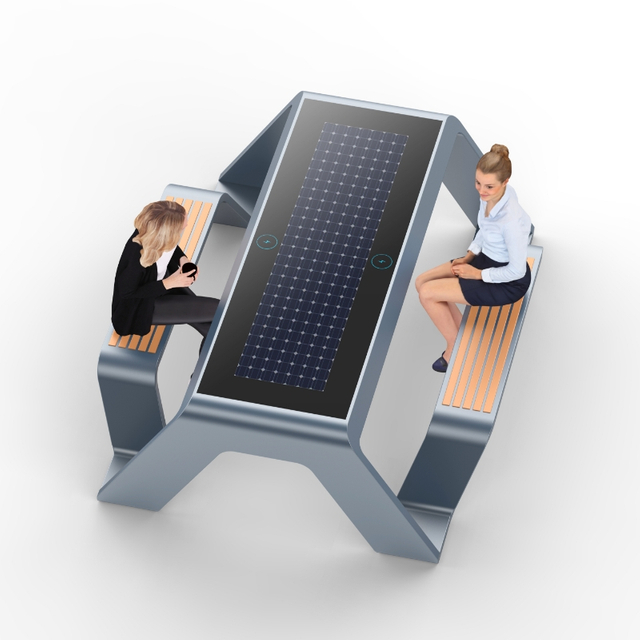
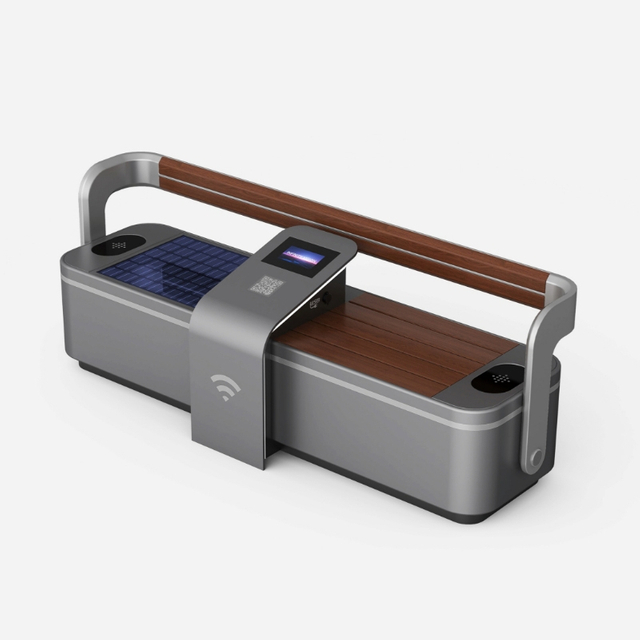
A solar panel can make public furniture look sustainable at first glance, but the harder question is what happens after installation. Will the unit match real energy needs, survive years outdoors, stay easy to maintain, and avoid full replacement when one part wears out?
For city managers, planners, and buyers, sustainable smart city furniture is best judged across its whole working life. That means looking beyond solar powered street furniture as a power source and considering installation, materials, maintenance, repairability, and real public use. These checks help distinguish eco-friendly urban furniture from designs simply packed with more technology.
Start With the Energy Load, Not the Solar Panel
What needs power during a normal day?
When planning sustainable smart city furniture, start with the service people need rather than the size of the solar panel. A bench that only provides phone charging has a very different energy load from one that also runs lights, Wi-Fi, speakers, heating, or a digital information screen. Every extra function needs electricity, and some may run for many hours each day.
This matters because a feature that sounds useful during planning may add little value at the actual site. A bus stop with long passenger waits may justify phone charging and night lighting. A quiet park bench used mainly during daylight may need much less. City buyers should therefore identify the daily public need first, estimate when each function will operate, and only then decide how much generation and storage the furniture requires.
A solar charging bench for public spaces works best when its power system is built around a realistic use pattern. Otherwise, the project can end up with too little stored energy for busy periods or with equipment that is larger and more complex than the site needs.
Public Function
Typical Use Pattern
What to Check Before Specifying
Phone charging
Short, repeated use throughout the day
Expected number of users and peak charging periods
Lighting
Mainly evening and night use
Operating hours and available battery capacity
Wi-Fi or connectivity
May run continuously
Whether continuous power use is justified by actual demand
Digital display
Longer operating periods and higher power demand
Screen operating hours, brightness needs, and available solar energy
Seat heating
Seasonal and relatively high power demand
Climate, operating schedule, and whether heating is needed at the site
Sensors and monitoring
Low but often continuous demand
Whether collected data will support maintenance or operations
How solar generation and battery storage work together
The basic energy flow is simple:
Sunlight → solar panel → battery → charging, lighting, and other services
Photovoltaic panels turn sunlight into electricity. Battery storage allows that electricity to be used later, including after sunset or when solar output falls. Solar generation can change with the time of day, season, clouds, shade, dust, and other site conditions, so storage helps balance changing production with the times when people need power.
That relationship is easy to see in a smart solar bench.ZEMSO ZY-0002combines solar generation, battery storage, device charging, lighting, and optional connectivity in one outdoor unit. Its battery-supported system can continue supplying power when sunlight is unavailable, while actual runtime varies with the amount of charging, lighting, and connectivity being used.
The key lesson is broader than one product. Solar generation should not be considered separately from storage and demand. A large panel cannot fix a design where the expected load has never been defined.
More smart functions are not automatically more sustainable
Extra functions can make public furniture more useful, but they also change its resource needs. A screen uses power. Heating adds another electrical load. Speakers, communication hardware, sensors, and lighting add components that may later need inspection or replacement.
The ZY-0003 shows this trade-off clearly. Its configuration can combine wired and wireless charging, solar power and battery storage, ambient lighting, a speaker, and optional seat heating. A transport hub may have a good reason for several of these services. A small neighborhood space may not.
The better sustainability question is therefore not, “How many smart features can we add?” It is, “Which functions will people actually use often enough to justify the energy, parts, and maintenance they require?”
For sustainable smart city furniture, a useful rule is simple: choose the public service first; size the technology second.
Count the Infrastructure Needed to Put It There
When off-grid power can simplify installation
The working life of a bench begins before anyone sits on it. Installation can require materials, labor, electrical connections, site access, foundations, and changes to the surrounding surface. These needs belong in the sustainability calculation.
Grid-powered street furniture may need a connection to an existing electrical network. Depending on the site, that can mean cable routing and related construction. A well-sized solar system with battery storage can remove the need for a separate power connection, which may simplify some projects.
Shanghai ZEMSO's ZY-0013 is one example. The unit combines an integrated photovoltaic panel and battery storage and can operate without a separate municipal electrical connection. This does not make installation impact-free, but it shows why solar powered street furniture can be useful in locations where bringing electrical power to the furniture would otherwise add work and infrastructure.
The installation advantage is strongest when the site has enough solar access and the expected electrical load is reasonable. Off-grid power is a design option, not a guarantee that every location is suitable.
A low-wiring installation still needs a good site
A solar bench still needs planning on the ground. The structure may need a secure foundation or anchoring system. Pedestrian routes must remain clear, and crews need enough access for later cleaning and repair. Drainage around the unit also matters because standing water and poor surface conditions can shorten the life of outdoor assets.
Sun exposure deserves special attention. Shadows, clouds, dirt, weather, and seasonal conditions can all change photovoltaic output. A bench placed under heavy tree cover may therefore generate less useful energy than the same unit in a more open location.
This creates a simple site-selection test. Before buying eco-friendly urban furniture, ask what must be built or disturbed around it, how well solar power will work there, and whether the position will remain practical for service crews.
The most sustainable installation is not always the one with the least wiring. It is the one that lets the furniture operate reliably without creating avoidable construction or service problems later.
Build for Years of Weather, Use, and Maintenance
Outdoor materials have to survive the actual location
Most of a piece of street furniture's life is not spent being installed. It is spent outdoors, exposed to weather and people every day.
That changes how material choices should be judged. Calling a material “green” tells a buyer very little about what will happen after years of rain, sun, moisture, temperature changes, cleaning, scratches, and heavy public use. If a surface fails quickly and must be replaced, more material, transport, and labor are needed.
For sustainable smart city furniture, durability is therefore part of resource efficiency. Buyers should ask how the frame is protected from corrosion, how seating surfaces handle UV and moisture, whether coatings can be repaired, and whether damaged panels can be replaced without rebuilding the whole unit.
Different locations may also need different answers. A coastal site, a hot open plaza, and a shaded transit stop do not place the same stress on materials. There is no single material that is automatically the most sustainable in every setting. The practical goal is to match construction to the environment so the asset can remain in service for as long as possible.
The electronics need protection too
A strong frame does not help much if the smart functions stop working after a short period. Charging ports, lights, batteries, displays, sensors, connectors, and internal wiring all face outdoor conditions as well.
Protection should therefore cover both the furniture and the electronics. ZY-0002 uses sealed electrical components and protected charging interfaces designed for outdoor exposure. The wider procurement question is how water, dust, physical wear, and repeated public use are kept away from vulnerable components.
Access also matters. A protected enclosure that is extremely difficult for maintenance staff to open can create a different problem. Good eco-friendly urban furniture should protect electronics while still allowing trained crews to inspect or replace them without dismantling large parts of the bench.
Maintenance should be simple enough to do regularly
No outdoor smart product is truly maintenance-free. Solar surfaces collect dirt. Charging ports are touched many times. Seals age. Batteries lose performance over time, and exposed parts can be damaged.
Maintenance becomes more sustainable when these routine tasks are easy to perform. Crews should be able to inspect charging points, check connections, clean solar surfaces, examine seals, and reach parts that are likely to wear. Small problems can then be fixed before they cause larger failures.
Cleaning has a direct link to energy performance because dirt and other obstructions can reduce the amount of sunlight reaching photovoltaic cells. For ZEMSO ZY-0002, routine care includes keeping the solar panel clean, while monitoring functions can track solar generation, battery status, and charging operation.
The exact maintenance schedule will depend on the local environment. A dusty roadside may need more attention than a cleaner, rainier location. The better procurement question is whether the city can realistically carry out the required care with the staff and service access it has.
Connected monitoring is useful when it leads to action
Smart monitoring can make maintenance more focused. Instead of visiting every unit only to discover that most are working normally, staff may be able to check basic operating information before going to the site.
For example, connected solar powered street furniture can report battery condition, solar generation, or whether a charging interface is working. ZY-0002 can monitor energy use, device status, and environmental conditions, while ZY-0006 includes remote equipment-status and maintenance functions.
The sustainability value comes from the action that follows the data. If a low battery reading leads staff to inspect shading, panel condition, or battery health, the information may help prevent longer downtime. If nobody checks the dashboard, the communication hardware simply becomes another component consuming resources.
A smart function earns its place when it helps the physical asset remain useful for longer.
Keep the Bench, Replace the Part That Wears Out
Not every component will age at the same speed
A smart bench is really a group of parts with different working lives. The structural frame may remain sound long after a battery reaches the end of its useful service period. Charging hardware can become worn or outdated while the seating surface is still fine. Communication modules may change faster than the solar panel.
Treating all these parts as one disposable object creates unnecessary waste. This is why repairability and modular design are central to sustainable smart city furniture.
A lifecycle-based procurement approach gives more weight to durability, repairability, reuse, and the ability to keep existing materials in service. That shifts attention away from the initial feature list and toward what happens when one part eventually wears out.
Cities therefore need to look beyond the first purchase. They also need to know what happens several years after installation when the first short-life component needs attention.
Replaceable modules can prevent unnecessary whole-unit replacement
A practical design separates long-life structural parts from components that are expected to wear sooner. If a battery fails, technicians should ideally replace the battery. If a charging module is damaged, the rest of the bench should stay where it is.
Shanghai ZEMSO's ZY-0006 illustrates this approach by separating structural, solar, battery, and electronic components with different expected working lives. Its battery and electronic modules can be replaced independently rather than requiring replacement of the complete bench.
Useful life also depends on whether people need the furniture
Repairability does not solve every problem. A durable, easy-to-fix bench still wastes resources if it is placed where people rarely use its services.
That makes real usefulness the final stage of the lifecycle test. A transit stop where passengers wait for long periods may make good use of charging and lighting. A public information display may be justified in a busy transport area where messages change often. In a quiet park, simpler sustainable smart city furniture may provide greater value with fewer powered components.
This is where project teams should be willing to remove functions. Fewer unnecessary modules can mean lower energy demand, fewer possible failure points, less maintenance work, and fewer replacement parts over the asset's life.
Conclusion
Sustainable smart city furniture works best when energy use, installation, durability, maintenance, repairability, and real public use are considered together. A smart solar bench should do more than generate renewable power; it should remain practical to service, fit the site, and keep useful parts in service for as long as possible.
Shanghai Zemso offers solar bench solutions that combine seating, solar power, charging, lighting, and other optional functions for public spaces. Matching those functions to actual project needs can help cities create useful amenities while avoiding unnecessary energy use, infrastructure, and replacement.