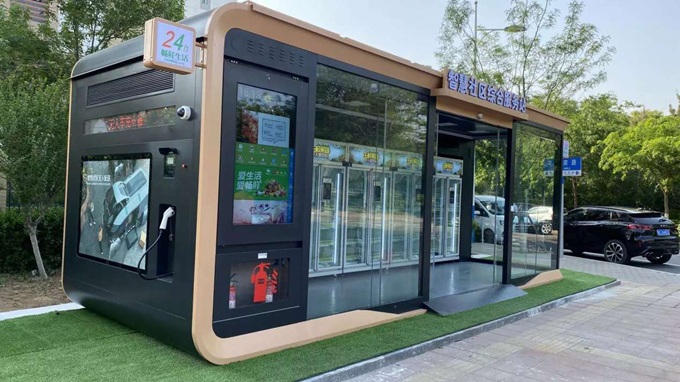
Located in Zibo, Shandong Province, this Smart Community Integrated Service Station showcases the fusion of modular architecture, renewable energy, and intelligent technology. Developed under the Modular Container House Series, the project serves as a benchmark for future-oriented urban infrastructure that supports community management, sustainability, and digital transformation.
Project Overview
The service station is composed of 20ft and 40ft modular containers, which can be expanded up to 80ft. Each unit is equipped with 100mm insulation or 150mm ultra-low temperature insulation capable of withstanding environments as cold as -40°C.
The power system integrates a 3kW solar system with lithium battery storage and a 10kW wind-solar hybrid system, ensuring continuous and eco-friendly power supply.
Built with galvanized steel and fireproof rock wool, the structure meets Class A fireproof standards and resists wind speeds up to Level 12, offering a lifespan of over 20 years.
Intelligent System Integration
The service station features an advanced intelligent control system that allows users to manage and monitor operations remotely via a mobile app. Equipped with AI voice assistant and facial recognition access control, it enhances safety, convenience, and operational efficiency.
The integrated IoT system provides real-time data on temperature, humidity, and energy usage, supporting smart energy management and proactive maintenance.
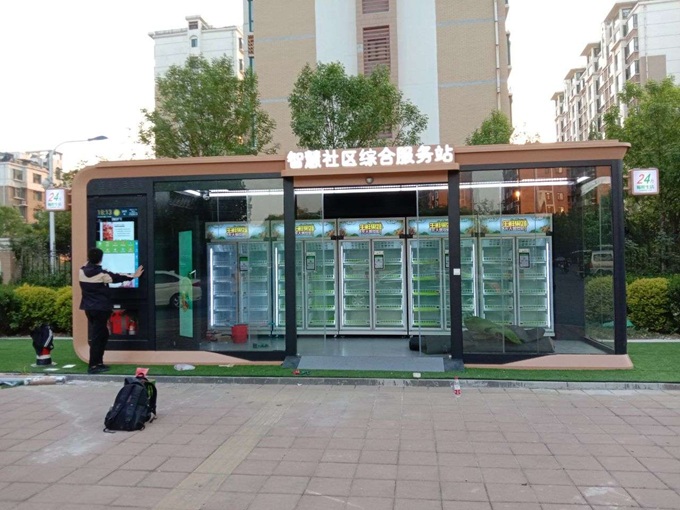
Impact on the Community
The Smart Community Integrated Service Station has significantly improved the quality of life and operational efficiency within the local community. Its impact can be summarized in several key aspects:
Enhanced Public Services
The station acts as a multifunctional community hub, providing residents with access to essential services such as information assistance, security management, and event coordination. Its modular design allows for flexible space usage — from administrative offices to resident consultation areas.
Energy Independence & Sustainability
By integrating renewable energy sources such as solar and wind power, the station operates with minimal reliance on external electricity grids. This contributes to a greener, low-carbon community, reducing operational costs and environmental impact.
Improved Safety and Convenience
Intelligent systems like face recognition access control and AI-assisted monitoring enhance community security, while smart lighting, temperature regulation, and automated alerts ensure comfort and safety for residents and staff.
Digital Transformation of Community Management
Through its remote management and IoT connectivity, the service station enables local authorities to efficiently monitor community data — from power usage to environmental conditions — fostering a smart, data-driven approach to urban governance.
Rapid Deployment and Adaptability
The modular container design allows for on-site assembly within 48 hours, making it ideal for both permanent and temporary installations. This flexibility ensures that the solution can quickly respond to changing community needs or emergency situations.
Conclusion
The Smart Community Integrated Service Station in Zibo represents a vital step toward building intelligent, sustainable, and people-centered urban communities. By combining modular architecture, renewable energy, and AI-driven management, it demonstrates how technology can bring tangible improvements to daily community life — creating safer, smarter, and more efficient living environments for the future.


